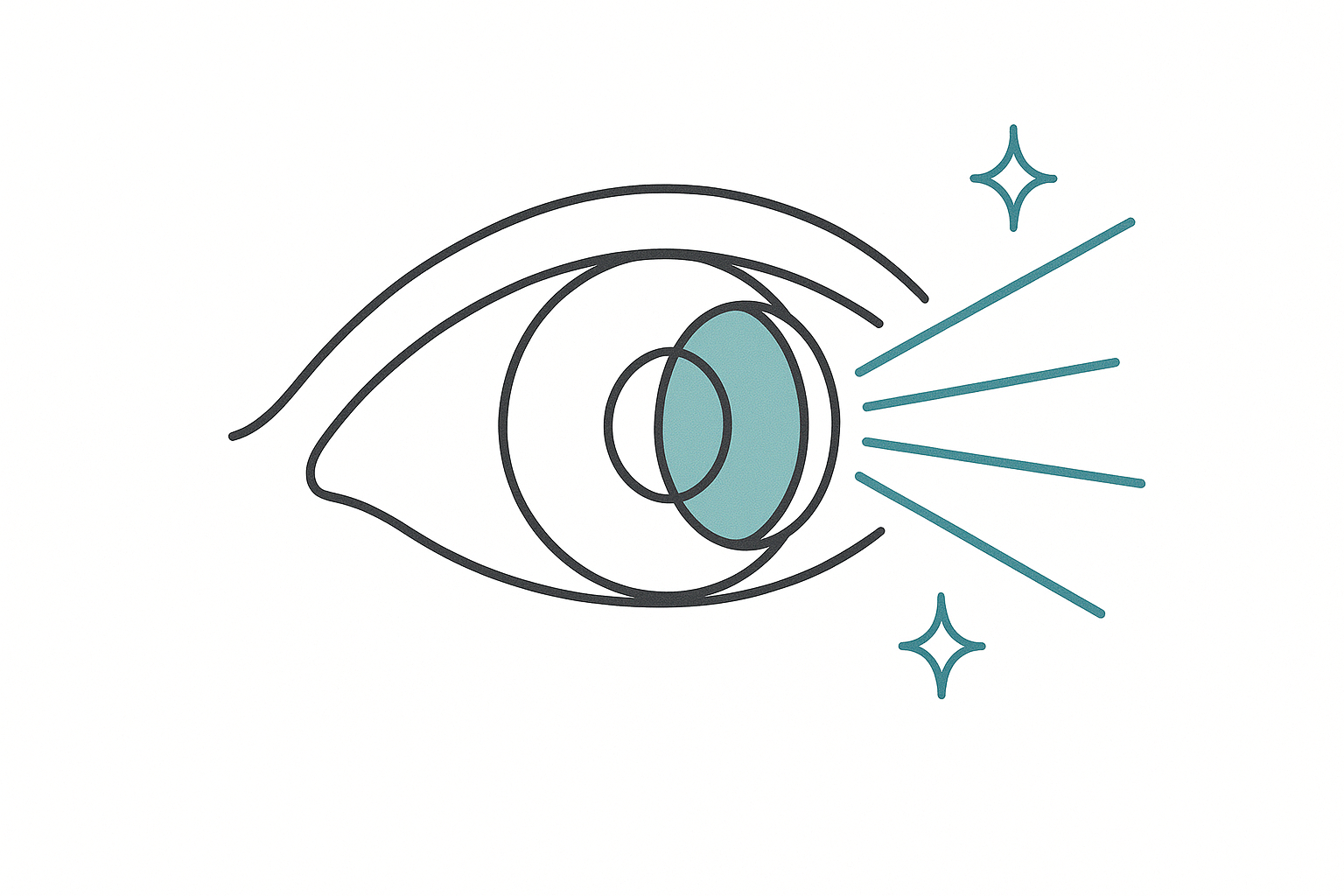
Inside your eye, there is a drainage system that keeps fluid flowing in and out at a steady rate. This system sits in a small space called the angle, located where the iris meets the cornea.
In most eyes, this angle is wide open, and fluid drains without any trouble.
In some eyes, the angle is anatomically narrow. The iris sits closer to the cornea than usual, which reduces the space available for fluid to drain. If the angle becomes too narrow, or closes entirely, fluid backs up and eye pressure rises, sometimes dangerously.
This is the mechanism behind narrow angle glaucoma, also called angle closure glaucoma.
Many patients with narrow angles have no symptoms until a crisis occurs. This is why the condition is often discovered during a routine eye exam, not because the patient felt something was wrong.
Here is where the two conditions connect.
Your natural lens sits directly behind the iris. As you age, the lens grows thicker. When a cataract develops, the lens becomes even thicker. In an eye that already has narrow angles, this additional thickness pushes the iris forward, further crowding the drainage angle.
In other words, a growing cataract can be actively making a narrow angle problem worse.
This creates a situation where two conditions that might seem unrelated are actually driving each other. The cataract is reducing your vision. The thickening lens is narrowing your angle. And the narrowing angle is increasing your risk of an acute pressure crisis.
This is why ophthalmologists pay close attention to angle anatomy when evaluating cataracts, especially in patients who are farsighted, female, of Asian descent, or who have a family history of glaucoma.
When narrow angles are identified, the traditional first step has been a laser procedure called a laser peripheral iridotomy (LPI). A small hole is created in the iris with a laser to allow fluid to bypass the pupil and flow more freely, opening the angle.
This is a quick, effective procedure. But it does not address the underlying cause of the crowding: the thickening lens.
When a patient has both a visually significant cataract and narrow angles, proceeding directly with cataract surgery can address both problems at once. Removing the thick natural lens and replacing it with a thin artificial lens opens the drainage angle, often dramatically.
The advantage: One procedure solves two problems. The cataract is removed, vision is restored, and the angle opens, reducing or eliminating the risk of angle closure. No separate laser procedure is needed.
In some situations, the narrow angle is identified before the cataract is ready for surgery. A laser iridotomy is performed to reduce immediate risk. Later, when the cataract becomes visually significant, surgery is scheduled.
The consideration: Eyes that have had a prior iridotomy can experience higher rates of corneal edema (swelling) after cataract surgery. The iridotomy changes the anatomy slightly and may affect how the eye responds during and after the procedure. This does not mean cataract surgery cannot be done. It means the surgeon should be aware of the history and prepared to manage the recovery accordingly.
If you have been told you have narrow angles and cataracts, the most important question is not just "when should I have surgery?" It is "what is the right sequence of treatment for my specific situation?"
For some patients, proceeding with cataract surgery and skipping the iridotomy entirely is the better path. The surgery itself opens the angle, and the patient avoids a separate procedure and its potential effects on the cornea.
For others, the angle may be dangerously narrow and the cataract not yet ready for surgery. In that case, a laser iridotomy provides essential protection now, and cataract surgery can happen later with appropriate planning.
The right answer depends on how narrow the angle is, how advanced the cataract is, and whether there is an immediate risk of angle closure. This is a judgment call, not a formula.
An acute angle closure attack occurs when the drainage angle closes suddenly and completely. Eye pressure spikes rapidly, sometimes to dangerous levels within hours.
Symptoms include:
This is a medical emergency. If you experience these symptoms, seek immediate care. Acute angle closure can cause permanent vision loss if not treated quickly.
For patients with known narrow angles, being aware of these symptoms is important. Most will never experience an attack. But knowing the warning signs can make the difference between a treatable event and a permanent one.
Narrow angles are more common in certain populations:
Many patients with narrow angles are identified during routine eye exams using a technique called gonioscopy, where the doctor examines the angle directly with a special lens. This is one of the many reasons comprehensive eye exams matter even when you feel fine.
If your ophthalmologist has told you that you have narrow angles and cataracts, here are the questions worth asking:
The answers will be different for every patient. That is why the evaluation and the conversation matter as much as the procedure itself.
Dr. Tokuhara evaluates both conditions together and helps you determine the right sequence of treatment for your eyes.