At least once a week, a patient sits down in my office for a cataract evaluation and tells me, almost as an afterthought, that they also have glaucoma. Sometimes they have been on eye drops for years. Sometimes they have had laser treatments. And sometimes their previous doctor mentioned glaucoma but never explained what it meant for their cataract surgery.
That last group concerns me the most. Because when glaucoma and cataracts coexist, the conversation about surgery changes in important ways. Not because surgery becomes dangerous, but because we have an opportunity to address both problems at once, and missing that opportunity means the patient may not get the full benefit of the procedure.
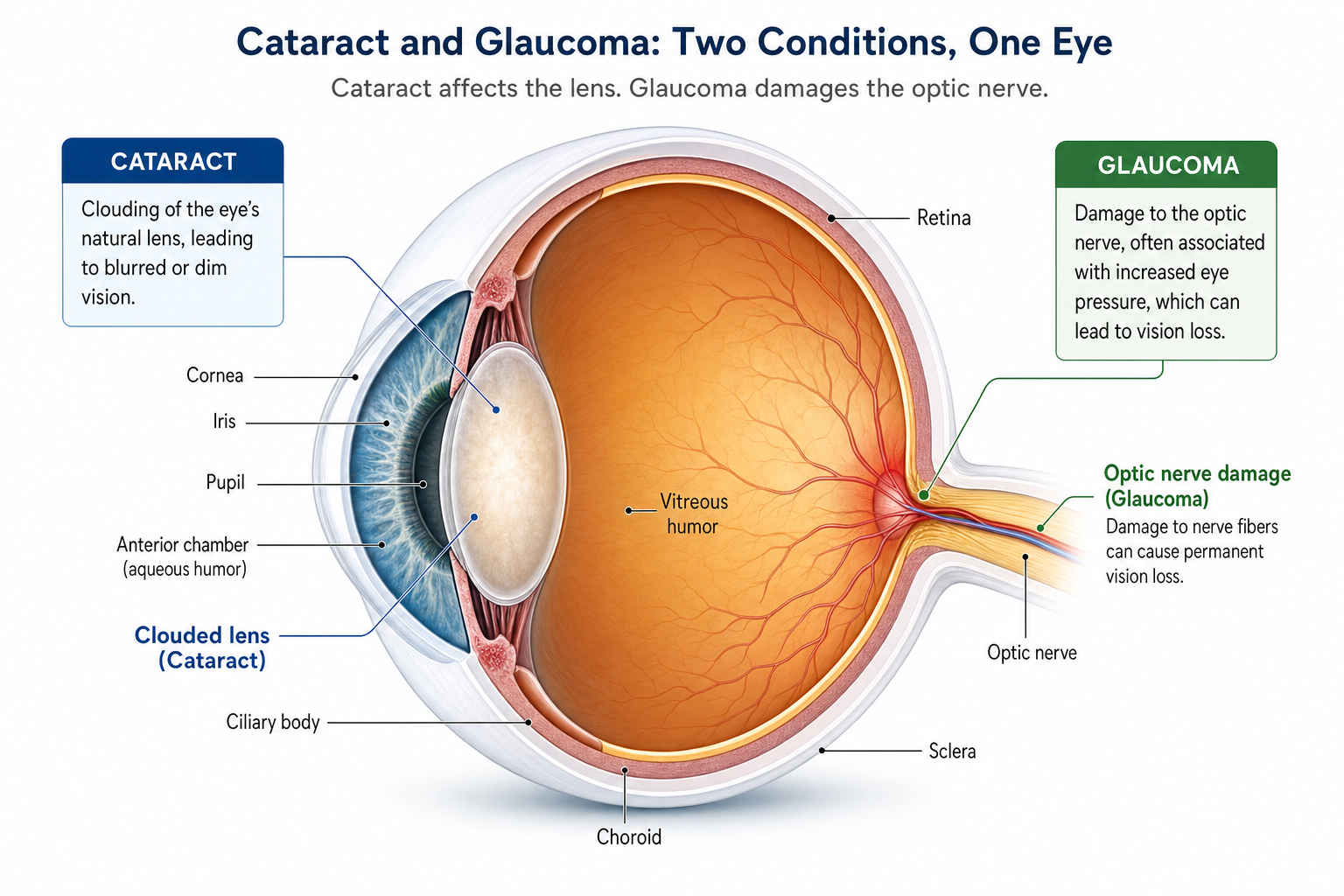
Cataracts and glaucoma are different diseases that happen to share the same real estate. A cataract is a clouding of the natural lens. It makes vision blurry, dim, or washed out, and it is fixed by replacing the lens with a clear implant. Glaucoma is damage to the optic nerve, usually driven by elevated pressure inside the eye. It steals peripheral vision slowly and silently, and the damage it causes is permanent.
Both become more common with age, which is why so many of my cataract patients also carry a glaucoma diagnosis. Some estimates suggest that up to 20 percent of cataract surgery patients have coexisting glaucoma or elevated eye pressure. That is not a small number.
The reason this matters for surgical planning is straightforward: if I am already inside the eye to remove the cataract, I have a window of opportunity to do something about the glaucoma at the same time. In many cases, a small additional procedure can lower eye pressure, reduce the number of daily eye drops a patient needs, or both. But this only happens if the conversation happens before surgery, not after.

Cataracts cloud the lens. Glaucoma damages the optic nerve. They are different conditions that frequently coexist, and addressing both during one surgery can benefit the right patients.
When a patient has only cataracts, the main decision is about the lens: which implant best matches their visual goals and lifestyle. When glaucoma is also present, the decision tree expands.
First, I think about lens selection differently. Multifocal lens implants, the ones that provide both distance and near vision, divide incoming light among multiple focal points. That division reduces contrast sensitivity slightly. For a patient with healthy optic nerves, this tradeoff is usually negligible. But for a patient who already has peripheral vision loss from glaucoma, even a small reduction in contrast can make a meaningful difference in how they see in low light, how well they perceive edges and depth, and how comfortable they feel driving at night.
This does not mean patients with glaucoma cannot have premium lenses. It means the decision requires more nuance. A patient with early, well-controlled glaucoma and minimal visual field loss may do perfectly well with a Vivity extended depth-of-focus lens. A patient with moderate field loss may be better served by a monofocal implant that preserves full contrast. The key is matching the lens to the whole eye, not just the cataract.
Glaucoma does not disqualify you from cataract surgery. But it does change which lens implant will give you the best functional result. The surgeon who manages both conditions is the one best positioned to make that recommendation.
Second, I think about the pupils. Many patients on long-term glaucoma drops, particularly certain classes of medications, develop pupils that do not dilate well. A small pupil makes cataract surgery more challenging because the surgeon needs to see and access the lens through the pupil. This is not a barrier to surgery, but it requires additional steps and experience. I may use devices to gently expand the pupil or adjust my surgical technique to work safely in a tighter space.
Third, I consider the opportunity for combined treatment. This is where the conversation gets most interesting for patients.
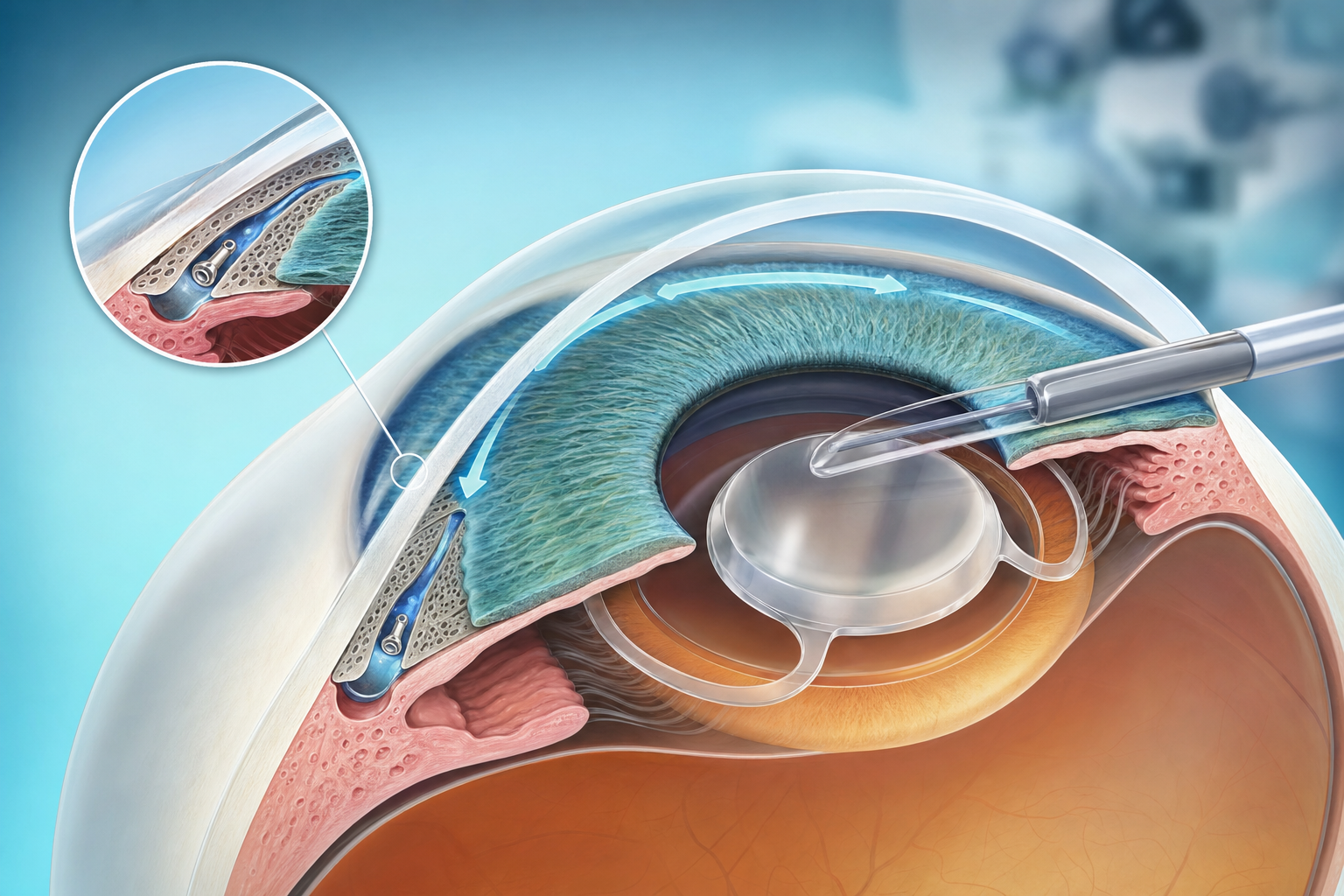
MIGS stands for minimally invasive glaucoma surgery. These are a family of small, low-risk procedures that can be performed through the same tiny incision already being used for cataract surgery. In most cases, a MIGS procedure adds only a few minutes to the total operating time. The patient does not notice any difference in their recovery.
The goal of MIGS is modest and realistic: lower eye pressure enough to reduce dependence on daily glaucoma drops, or provide a buffer of pressure reduction that protects the optic nerve over time. MIGS is not a cure for glaucoma. It does not replace more aggressive surgical options when they are needed. But for patients with mild to moderate glaucoma who are already having cataract surgery, it represents a meaningful opportunity.
Several MIGS options exist. Some involve placing a tiny stent in the eye's natural drainage canal to improve fluid outflow. Others directly open the drainage pathway using specialized instruments. Each approach has strengths and limitations, and the best choice depends on the type and severity of glaucoma, the anatomy of the drainage angle, and what will work best for a particular eye.
What I tell patients is this: if you have glaucoma and you are already planning cataract surgery, we should talk about whether MIGS makes sense for you. For the right patient, it means coming out of cataract surgery with clearer vision and lower eye pressure, sometimes with fewer drops than before. That is a real benefit.

MIGS procedures are performed through the same small incision used for cataract surgery, adding only minutes to the procedure while offering meaningful pressure reduction for the right patients.
Glaucoma drops are a daily reality for millions of people, and most patients tolerate them. But they are also a source of real frustration. The drops can be expensive, even with insurance. They can cause red eyes, stinging, eyelash changes, and chronic irritation of the eye surface. Remembering to use them one, two, or three times a day is a burden that accumulates over years.
I have patients who have been on multiple glaucoma drops for a decade or more. When I tell them there is a possibility of reducing that burden during their cataract surgery, the conversation changes. They lean forward. They want to understand.
Here is what I explain: after combined cataract and MIGS surgery, some patients are able to reduce their drops from three to one, or from two to zero. Others maintain the same regimen but achieve lower pressures than before, which provides a margin of safety for the optic nerve. And some patients, particularly those with more advanced glaucoma, will continue needing their full drop regimen because the disease requires that level of treatment.
I never promise that drops will go away. But I think it is worth having an honest conversation about the possibility. Patients deserve to know that the option exists, even if the outcome is uncertain.
"I had been putting three different drops in my eyes every day for eight years. After my cataract surgery, Dr. Tokuhara told me to stop two of them. My pressure has been perfect on just one drop ever since."
MIGS works best for mild to moderate glaucoma. Patients with advanced disease, those who have significant visual field loss, high pressures despite maximum medications, or a history of previous glaucoma surgery, may need more than what MIGS can offer.
For these patients, cataract surgery and glaucoma treatment may need to be staged separately, or a more traditional glaucoma surgery like a trabeculectomy or tube shunt may be more appropriate. In some cases, doing the cataract surgery first and stabilizing the eye before addressing the glaucoma surgically is the safest approach. In others, addressing the glaucoma first and deferring the cataract makes more sense.
These are not simple decisions, and they are the kind of decisions that benefit from a surgeon who manages both conditions regularly. The planning matters as much as the surgery itself.
There is a specific scenario I see frequently that deserves its own mention. Some patients have what is called narrow angles, a condition where the drainage pathway inside the eye is anatomically crowded. In these eyes, the natural lens, especially as it thickens with age, pushes against the iris and narrows the space where fluid drains out of the eye. This creates a risk of acute angle-closure glaucoma, a sudden and painful spike in eye pressure that can cause permanent damage in hours.
For these patients, cataract surgery is not just about improving vision. Removing the thickened natural lens and replacing it with a thin artificial implant physically opens up the drainage angle. In many cases, this eliminates the risk of angle closure entirely. It is one of those situations where cataract surgery treats two problems at once: cloudy vision and a structural glaucoma risk.
I have seen patients referred to me specifically for this reason, people whose glaucoma specialist recognized that the best way to manage their angle closure risk was to remove the cataract, even if the cataract was not yet causing significant vision problems. In the right clinical context, earlier cataract surgery can be the most effective glaucoma prevention strategy available.
If you have both glaucoma and cataracts, here are the questions that matter most before surgery:
Having glaucoma does not prevent you from having cataract surgery. In many cases, it makes cataract surgery more valuable, because the procedure can address both conditions at once.
But it does require a broader conversation. The lens selection is different. The surgical planning is different. The opportunity to combine treatments changes the equation. And the surgeon's experience with both conditions determines whether you get the full benefit of that opportunity.
If you have been told you have glaucoma and cataracts, do not think of them as separate problems that need separate solutions. Think of them as two conditions that can be managed together, with the right plan and the right surgeon.

Managing glaucoma and cataracts together requires a broader surgical conversation. The best outcomes come from planning that accounts for both conditions from the start.
If you are managing glaucoma and considering cataract surgery, the conversation about how to treat both conditions starts before you enter the operating room. Understanding your options helps you make a more informed decision about your care.
Talk to your ophthalmologist about whether combined cataract and MIGS surgery is right for your situation. The best outcomes come from plans that account for the whole eye, not just the cataract.