One of the most memorable lessons about vision did not come from a textbook. It came from a 75-year-old cyclist preparing for his annual summer ride to Idaho.
He came to our office for a cataract evaluation because his vision had gradually become more difficult while riding and driving. Like many active patients, he wanted the sharpest possible distance vision for the activities he loved most.
After discussing his options, he chose a monofocal lens designed for distance vision in his first eye. The surgery went beautifully.
The next day, his vision in the operated eye was already noticeably clearer. But instead of celebrating his newfound clarity, he described a strange and frustrating sensation.
His explanation stopped me in my tracks.
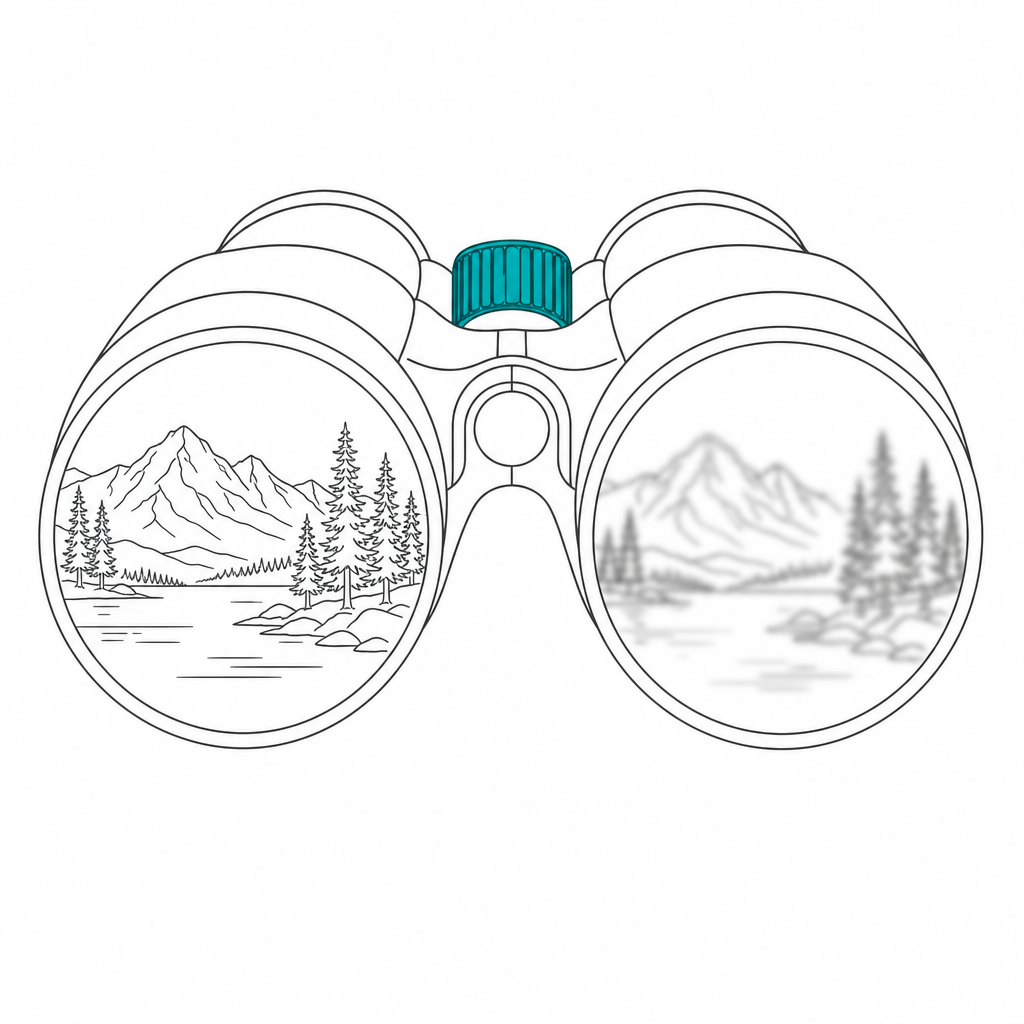
“Have you ever picked up a pair of binoculars? You know how there’s a little wheel in the middle that you turn until everything snaps into focus? That’s what my eyes feel like right now. It’s as if I’m turning that wheel over and over, trying to get both sides to match, but it never quite gets there.”
It was one of the most accurate descriptions of anisometropia I have ever heard.
Anisometropia occurs when there is a significant difference in prescription between the two eyes. In his case, the newly operated eye was seeing clearly at distance while the other eye still had the refractive error and cataract it had always had. The difference was roughly three diopters.
On paper, that may not sound dramatic.
In real life, the brain suddenly receives two very different images. One image is clearer. One image is blurrier. The images may even appear slightly different in size. The eyes themselves may be healthy, but the visual system struggles to combine those images into one comfortable picture.
Many patients describe headaches, eye strain, imbalance, or difficulty with depth perception. Others simply say that something feels “off.”
For this cyclist, the binocular analogy captured it perfectly. No matter how hard he tried, the focusing wheel never seemed to reach the right setting.
This is why cataract surgeons frequently discuss anisometropia before surgery, particularly when we expect a difference of three diopters or more between the eyes. While some patients tolerate it quite well, others find it surprisingly disruptive.

His second eye could still be corrected to about 20/30. By traditional standards, that is not terrible vision. But visual quality is about more than letters on an eye chart. It is about how comfortably the two eyes work together.
Because his symptoms were significant, we decided to proceed with cataract surgery in the second eye.
Afterward, everything changed.
The binoculars finally came into focus.
Both eyes were working together again. The imbalance disappeared. His distance vision was sharp, comfortable, and natural. Most importantly, he was able to get back to the activities that mattered most to him.
Not long afterward, he headed off on his annual trip to Idaho, ready for another season of cycling and adventure.
His story serves as an important reminder that cataract surgery is not simply about improving the vision in one eye. It is about restoring the way both eyes work together as a team.
Sometimes the most important measurement is not what we see on the eye chart. It is whether the patient can once again experience the world comfortably, clearly, and without having to keep turning the focusing wheel.
If something feels off after surgery in one eye, or if you are considering surgery and want to understand what to expect, we are here to help.