It usually starts the same way. A patient calls the office, sometimes anxious, sometimes frustrated. "My vision was great after surgery," they say. "Now it feels like my cataract is coming back." I hear some version of that conversation several times a month. And every time, the first thing I tell them is this: your cataract is not back. It cannot come back. What you are experiencing is something different, something predictable, and something we can fix.
It is called posterior capsule opacification. Most doctors abbreviate it PCO. Some patients hear it called a "secondary cataract," which is technically a misnomer but has stuck because it describes the symptom so well: cloudy vision that feels exactly like the cataract did before surgery. The difference is in what is causing the cloudiness, and how easy it is to treat.
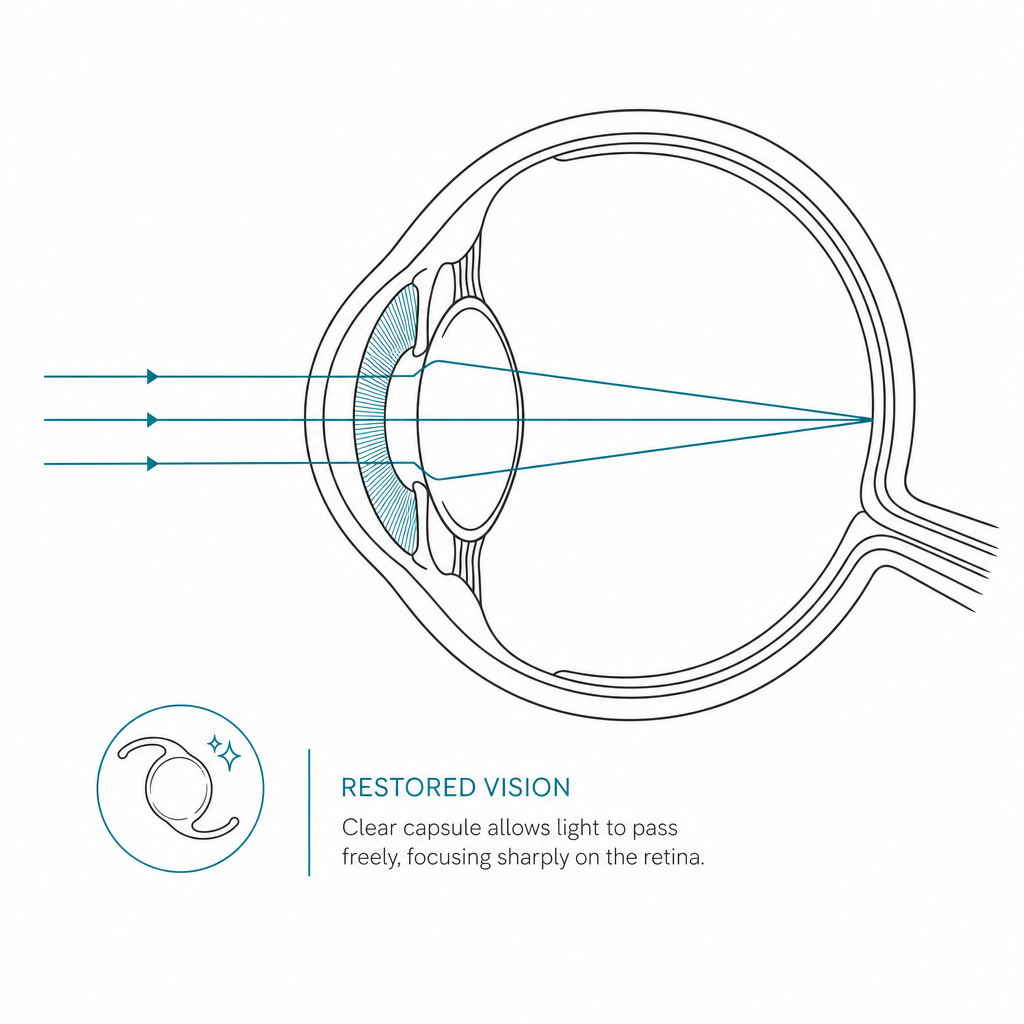
During cataract surgery, I remove the cloudy natural lens from inside your eye and replace it with a clear artificial lens implant. That implant sits inside a thin, transparent membrane called the capsular bag. Think of it like a cellophane wrapper: during surgery, I open the front of the wrapper, remove the cloudy lens, and place the new implant inside. The back of the wrapper, the posterior capsule, stays intact. It holds the implant in position.
Over time, cells from the remaining lens capsule can migrate across the back surface of that membrane. These cells are not abnormal. They are not scar tissue in the traditional sense. They are remnant lens epithelial cells doing what cells do: growing, dividing, spreading. As they accumulate on the posterior capsule, the membrane becomes hazy. Light scatters instead of passing cleanly through, and your vision gradually becomes cloudier.
PCO is not a complication. It is not a sign of bad surgery or a bad lens. It is a normal biological response that happens in roughly 20 to 40 percent of patients within five years of cataract surgery. It is one of the most predictable events in ophthalmology, and one of the most treatable.
I tell patients to think of it this way: if you cleaned a window perfectly but a thin film slowly built up on the inside of the glass, you would not say the window was broken. You would clean the film. That is essentially what we do with PCO.
The symptoms of PCO are often indistinguishable from the original cataract. That is exactly why patients assume the cataract has returned. You may notice:
The onset is usually gradual. Most patients describe a slow decline over weeks or months, not a sudden change. Some notice it more in certain lighting conditions. Others realize it when they compare how well they see now versus how well they saw in the first few months after surgery.
A patient once told me: "I thought I was imagining it. My surgery was two years ago, and everything was perfect. Then over the last few months, it felt like I was looking through a dirty windshield. I kept cleaning my glasses, thinking that was the problem. It was not."
If this sounds familiar, it is worth knowing that you are not alone, and you are not imagining it. The clouding is real, and it has a straightforward explanation.
The honest answer is that we cannot completely prevent it. During cataract surgery, I remove the lens material as thoroughly as possible, but microscopic lens cells remain on the capsular bag. Those cells are alive, and over time, they proliferate. They migrate across the posterior capsule like frost forming on a window. The process is slow, usually taking months to years, and the rate varies from person to person.
Several factors influence how likely it is and how quickly it develops:
The treatment for posterior capsule opacification is a procedure called YAG laser capsulotomy. It is named after the type of laser used: a Nd:YAG (neodymium-doped yttrium aluminum garnet) laser. The name is technical. The procedure is not.
Here is what happens. You sit at a slit lamp, which looks like the same machine used during a regular eye exam. Your pupil is dilated, and a focusing lens is placed on your eye. The laser delivers a series of focused pulses to the cloudy posterior capsule, creating a small, clean opening in the center of the membrane. Light can once again pass through clearly to the retina. The entire procedure takes about five minutes.
YAG laser capsulotomy is painless. No incision. No operating room. No sedation. You may see a few flashes of light during the procedure and hear some clicking sounds. Most patients notice improvement in their vision within hours. Some see clearly immediately. For others, it takes a day or two as the eye settles.
It is one of the most commonly performed procedures in ophthalmology, and one of the most satisfying for both patients and doctors. The moment you clear that membrane and the patient's vision sharpens, they often say the same thing: "It's like my surgery all over again."
After the procedure, you may notice some floaters. These are small fragments of the capsule membrane floating in the gel inside your eye. They are normal and typically settle within a few days to weeks. Your eye may be slightly irritated, and you will usually use anti-inflammatory drops for a brief period. There are no restrictions on activity. You can drive, read, and go about your day normally.
Once the posterior capsule has been opened, PCO does not come back. The opening is permanent. You will not need the procedure again on that eye.
The medical facts are straightforward, but I have learned over 20,000 surgeries that the emotional experience of PCO matters just as much. Patients invest trust, hope, and sometimes significant money into cataract surgery. When their vision starts to decline again, even gradually, it shakes that confidence. Some worry the surgery was not done right. Some wonder if they chose the wrong lens. Some feel embarrassed for "complaining" when they know others have had worse outcomes.
I always spend time explaining PCO to my patients before their cataract surgery, not after. If they know in advance that this is a possibility, a common one, and that it has a simple fix, it changes how they experience it if it happens. Instead of panic, there is recognition. Instead of doubt, there is a phone call. "I think I might have that capsule thing you told me about." That sentence is the difference between a patient who trusts their care and one who questions it.
If no one told you about PCO before your surgery, that does not mean your surgeon did something wrong. But it does mean you might be feeling more alarmed than you need to. This is normal. This is common. And this is fixable.
If your vision after cataract surgery was good and has gradually become cloudier, call your ophthalmologist. There is no urgency. PCO is not an emergency. But there is also no reason to tolerate declining vision when the fix is this straightforward.
Your doctor will examine you, confirm whether PCO is the cause, and if so, schedule a YAG capsulotomy. In most cases, the entire process from diagnosis to treatment to clear vision takes days, not weeks. Some offices can do the laser on the same day as the diagnosis.
I would add one important caveat: not all cloudy vision after cataract surgery is PCO. Other conditions, including macular degeneration, diabetic changes, or dry eye, can also cause blurred vision. That is why it is important to have an exam rather than assume. A proper evaluation takes minutes and gives you a clear answer.
Before every cataract surgery, I mention PCO. I tell patients that their surgery has a high probability of giving them excellent vision, and that there is a chance, roughly one in three to one in four over the next several years, that the capsule behind their new lens may become hazy. If it does, we fix it with a quick laser procedure that takes about five minutes.
I tell them this not to alarm them, but to prepare them. Because in my experience, the patients who understand what PCO is before it happens handle it completely differently than those who are caught off guard. There is no fear. There is no "my cataract is back." There is just a calm phone call and a quick fix.
Good cataract care does not end when you leave the operating room. It includes the months and years afterward, including knowing what to watch for, what is normal, and when to come back. PCO is part of that long-term conversation, and treating it well is part of treating the whole patient.
If your vision was clear after cataract surgery but has gradually become hazy, you may have posterior capsule opacification. A quick exam can confirm it, and the treatment is fast, painless, and permanent. You do not need to live with blurry vision.
Schedule an EvaluationYAG laser capsulotomy takes five minutes, requires no incision, and restores the clear vision you had after your original surgery. Learn exactly what to expect.
Read the YAG Laser Capsulotomy Guide