Nearly every week, I see a patient who is worried about floaters. They describe small dark spots drifting across their vision, little threads or cobwebs that move when they try to look at them, shapes that seem to swim just out of focus. Some have been noticing them for years. Others woke up that morning and saw something new.
The conversation that follows depends entirely on which of those two stories they are telling me. Because the floaters themselves are not the issue. The issue is what they represent, and whether the eye is telling you something that needs attention right now.
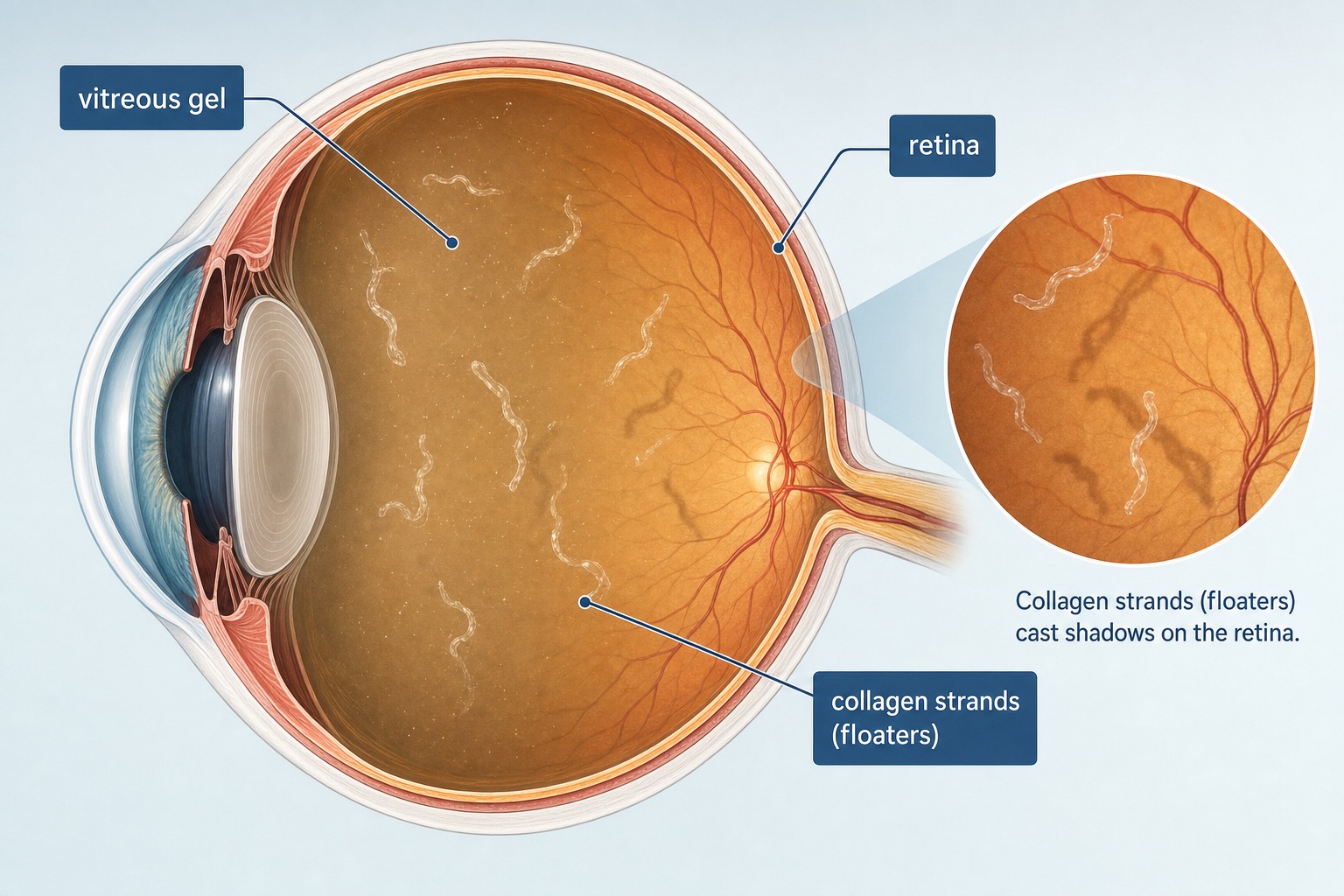
The inside of your eye is filled with a clear gel called the vitreous. When you are young, the vitreous is firm and transparent, like a perfectly set gelatin. As you age, it begins to liquefy and shrink. Small strands of collagen within the gel clump together, forming tiny shadows that fall on your retina, the light-sensitive tissue at the back of the eye.
Those shadows are floaters. They are not on the surface of your eye. They are inside it. That is why blinking does not clear them and why they drift when you move your gaze, always lagging slightly behind where you are trying to look.
For most people, this process is gradual. A small floater appears in your thirties. Another joins it in your forties. By your fifties and sixties, you may have a collection of small spots that you have learned to ignore. This is normal aging. It does not mean something is wrong with your eye.

Floaters are shadows cast on the retina by tiny clumps of collagen inside the vitreous gel. They are inside the eye, not on its surface, which is why they drift when you move your gaze.
There is a moment in most people's lives when the vitreous separates from the retina. This is called a posterior vitreous detachment, or PVD, and it is one of the most common events in ophthalmology. It happens to most people after age 60, though it can occur earlier in people who are nearsighted, have had eye surgery, or have experienced trauma to the eye.
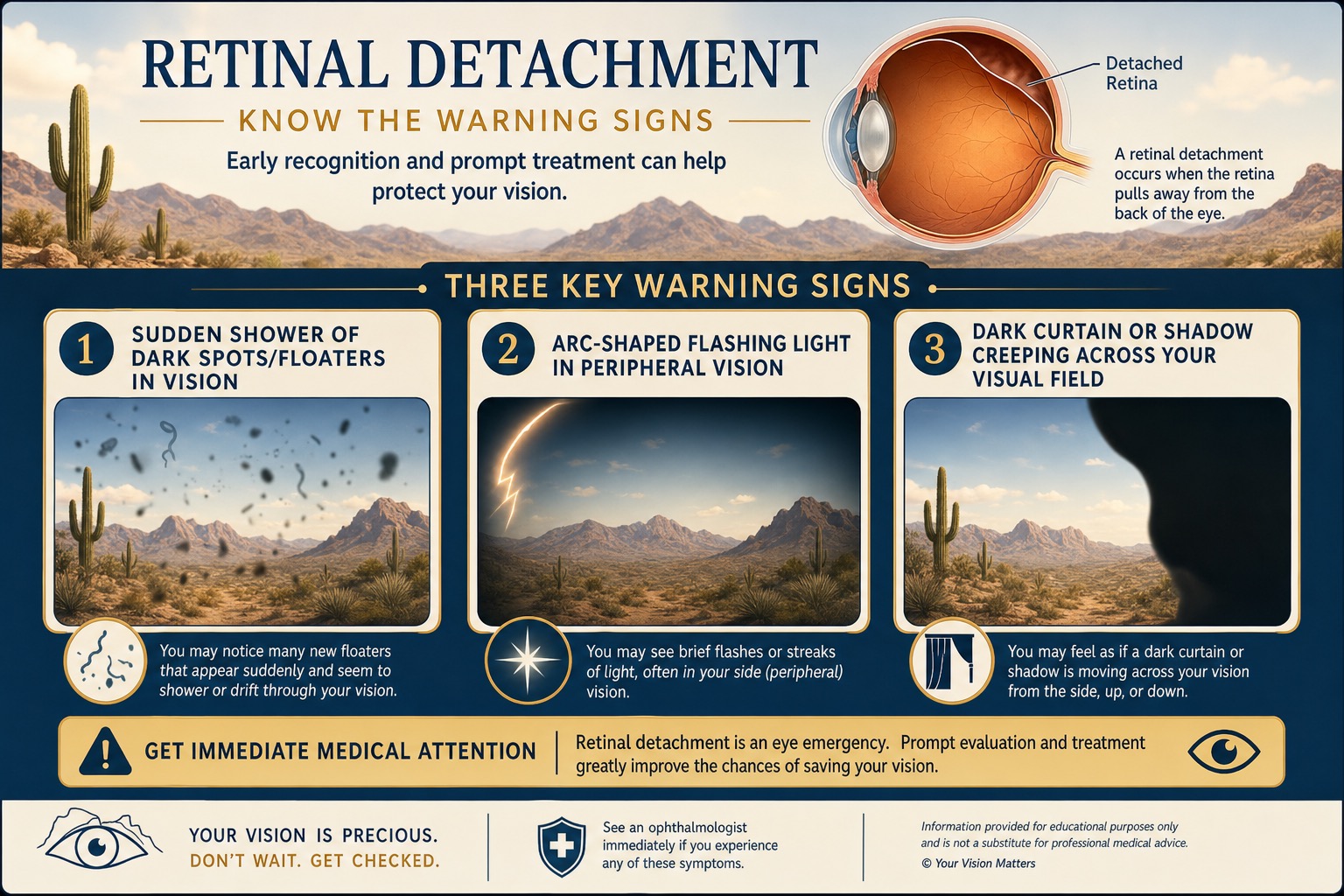
When the vitreous pulls away from the retina, it often creates a sudden burst of new floaters. Patients describe it as a shower of spots, a cloud of tiny dots, or a large new ring-shaped floater that was not there before. Some see cobweb-like strands. The onset is sudden, sometimes over the course of minutes.
This is also when flashing lights may appear. As the vitreous tugs on the retina during the separation, the mechanical pull stimulates the retinal cells. Your brain interprets that stimulation as light, even though no light is actually entering the eye. Patients describe the flashes as brief arcs of light in the periphery, like a camera flash going off to the side, or like seeing lightning in the corner of their vision. Flashes are often more noticeable in dim lighting or when the eyes are closed.
A posterior vitreous detachment is the most common cause of new floaters and flashes. In most cases, it is harmless. But it is also the mechanism behind most retinal tears. That is why it requires evaluation.
Most of the time, the vitreous separates cleanly. It pulls away from the retinal surface, the flashes gradually stop over days to weeks, and the new floaters slowly become less prominent as the brain learns to filter them out. No treatment is needed.
But sometimes the vitreous does not separate cleanly. If it is adhered strongly to a particular spot on the retina, the pulling force can tear the retinal tissue. A retinal tear is a small rip in the thin layer of tissue that captures light and sends signals to your brain.
A tear by itself does not cause vision loss. But fluid from inside the eye can seep through that tear and get behind the retina, lifting it away from the wall of the eye like wallpaper peeling from a wall. That is a retinal detachment, and it is a true surgical emergency.
The window between a retinal tear forming and a full detachment developing can be hours, days, or sometimes weeks. This is why timing matters. A retinal tear caught early can be sealed with a brief laser procedure in the office, preventing detachment entirely. A retinal detachment that has already occurred requires surgery to repair, and the visual outcome depends on how much of the retina detached and how quickly it was treated.

The warning signs of a retinal tear: a sudden shower of new floaters, flashing lights, and a dark shadow or curtain moving across your field of vision. Any of these warrants same-day evaluation.
After more than twenty years of examining patients with floaters, I have learned that patients are remarkably good at distinguishing between old floaters and something new. They know their eyes. When a patient tells me something changed today, I listen.
Here are the specific symptoms that warrant same-day evaluation:
"I thought it was just floaters. But when I saw the shadow, I knew something was different. I called the office that morning, and by the afternoon Dr. Tokuhara had treated a retinal tear with laser. He told me if I had waited a week, I might have needed surgery."
Not every floater is an emergency. In fact, most are not.
If you have had a small, stable floater for months or years that has not changed, that is almost certainly benign. If you notice a single tiny new spot but have no flashes, no shadow, and no change in vision, it is reasonable to call your eye doctor and describe the symptoms rather than rushing to the emergency room. Your doctor can determine the appropriate timing for an examination based on what you describe.
The distinction I use in my own practice is simple: sudden and multiple versus gradual and isolated. A sudden shower of floaters with flashes is urgent. A single small floater that appeared sometime last week is worth mentioning at your next visit.
I also tell patients that anxiety about floaters is common and understandable. Once you become aware of a floater, it is hard to stop noticing it. You may find yourself constantly checking your vision, looking at white walls, scanning for changes. This is a normal response, not a sign that something is getting worse. Over time, most people find that their brain adapts and the floater fades into the background.
Some people are more likely to experience a posterior vitreous detachment, and therefore more likely to develop a retinal tear. Understanding your risk helps you know when to be more alert to changes in your vision.
When you come in for evaluation of new floaters or flashes, the most important part of the visit is a dilated eye exam. I place drops in your eyes to widen the pupils, which allows me to see the retina clearly from the center all the way to the far periphery where tears are most likely to occur.
Using specialized lenses and a bright light, I examine the retinal surface in detail. I am looking for tears, thin spots, areas where the vitreous is still attached and pulling, and any signs that fluid has started to accumulate behind the retina.
The exam takes about 15 to 20 minutes once the eyes are dilated. It is painless, though the light is bright. Your vision will be blurry for several hours after dilation, so you will want to have someone available to drive you or plan to wait until the drops wear off.
If I find a retinal tear, I can often treat it the same day with laser. The laser creates a controlled area of adhesion around the tear, essentially welding the retina down and preventing fluid from getting underneath. The procedure takes a few minutes, is done in the office, and most patients feel only a mild sensation during treatment.
If the retina looks healthy and the vitreous is simply separating in the expected way, I send you home with reassurance and a clear set of instructions about what to watch for in the coming weeks. In some cases, I will ask you to return in four to six weeks for a follow-up exam, because a small percentage of retinal tears develop in the weeks after the initial vitreous separation, not during it.

A dilated exam is the single most important step when evaluating new floaters or flashes. It allows the surgeon to see the entire retina, including the far periphery where tears most commonly occur.

For the majority of patients, the answer is simple: the floaters are not dangerous, and over time they will bother you less than they do right now.
This can be frustrating to hear, especially when a floater is prominent and you notice it every time you look at the sky, read a book, or work on a computer. But the brain is remarkably good at adapting. Within weeks to months, most patients report that the floaters are still technically there but they have stopped paying attention to them. The floaters may also physically settle lower in the eye, moving out of the central line of sight.
I sometimes compare it to a clock ticking in a quiet room. At first, it is all you can hear. After a while, you stop hearing it entirely, even though the clock has not gotten quieter. Your brain has simply decided that it is not important information and filters it out. Floaters follow a similar pattern.
The goal is not to eliminate floaters. It is to confirm they are harmless, understand what they mean, and know what changes would require you to come back.
In rare cases where floaters are so dense and central that they significantly impair quality of life, a surgical procedure called vitrectomy can be considered. This involves removing the vitreous gel and replacing it with a clear saline solution. It is effective but carries real surgical risks, including cataract acceleration and, ironically, retinal detachment. I reserve this option for patients who are genuinely debilitated by their floaters after months of observation, and only after a thorough discussion of the tradeoffs.
Floaters are one of the most common reasons patients call my office. Most of the time, I can provide reassurance. The eye is aging normally, the retina is healthy, and the symptoms will gradually become less noticeable.
But that reassurance only comes after an exam. And the timing of that exam matters.
If you experience a sudden shower of new floaters, flashing lights, a shadow or curtain in your vision, or any sudden change in visual clarity, call your eye doctor that day. Do not wait for a routine appointment. Do not assume it will resolve on its own. These symptoms need a dilated exam to rule out a retinal tear or detachment.
If you have had stable, familiar floaters for months or years and nothing has changed, bring it up at your next exam. It is worth mentioning, but it does not require urgent evaluation.
The difference between a floater that is annoying and a floater that is dangerous is usually context: when it appeared, how quickly, and what other symptoms came with it. You do not need to diagnose yourself. You just need to know when to call.
Sudden changes in your vision warrant prompt evaluation. Desert Vision Center can typically accommodate same-day or next-day urgent visits for new floaters and flashes.
Desert Vision Center
35900 Bob Hope Dr, Suite 175
Rancho Mirage, CA 92270
Serving Rancho Mirage, Palm Desert, Indian Wells, La Quinta, Palm Springs, and the Coachella Valley.
Schedule Your Evaluation