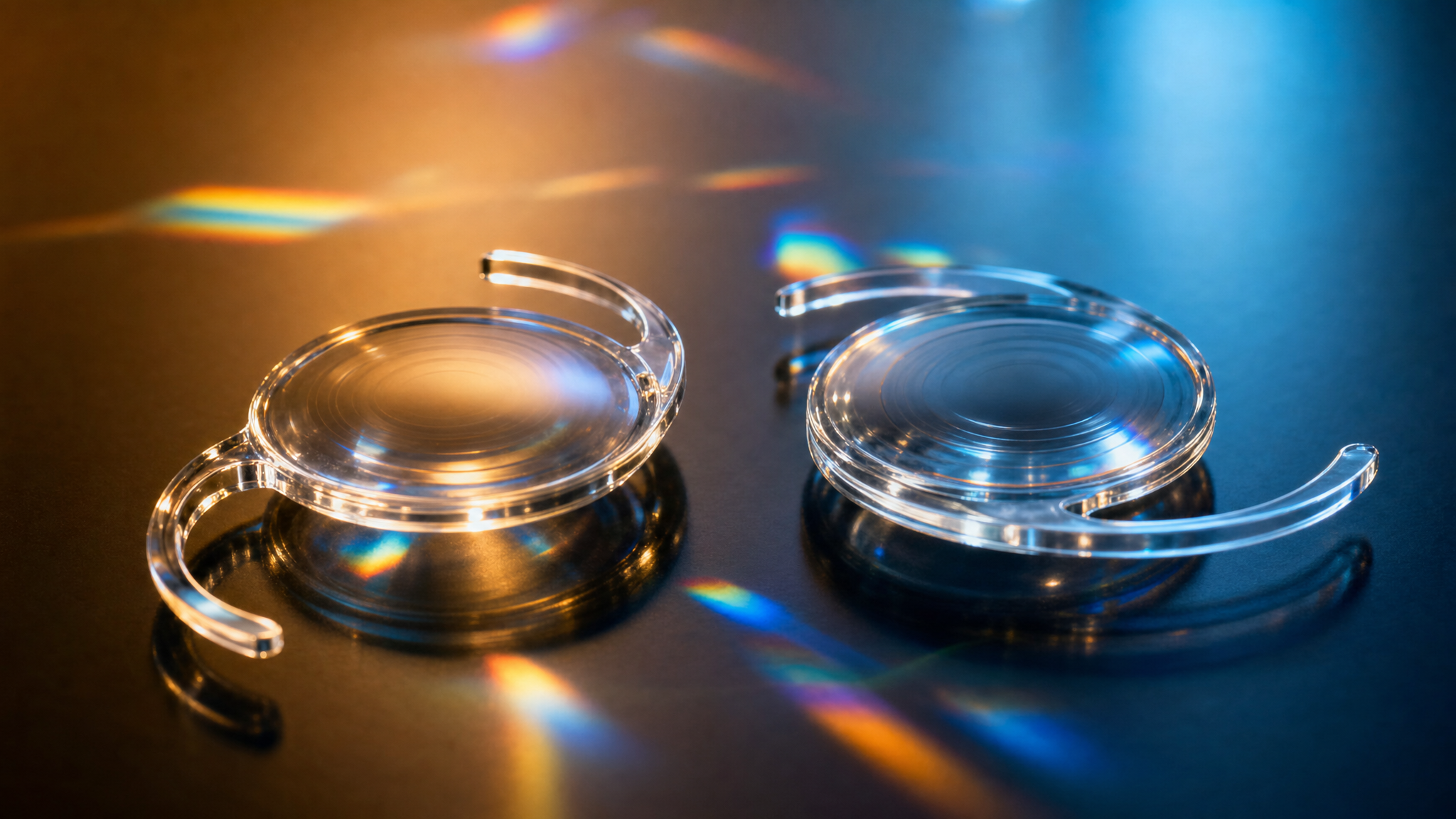
Same trifocal architecture. A meaningful optical refinement. Here is what actually changed, and whether it matters for your surgery.
I was the first surgeon in the Coachella Valley to implant the PanOptix Pro. That distinction came with an early clinical education, including a patient who had the original PanOptix in one eye and the Pro in the other, and could compare both directly within 24 hours of her second surgery.
That comparison is worth sharing in detail. But first, the basics.
Both lenses are made by Alcon. Both are trifocal intraocular lenses. Both deliver three focal points: distance, 60 cm for intermediate tasks like a computer screen or dashboard, and 40 cm for near work like reading. The architecture is the same. What improved in the Pro is in the optics themselves.


Before getting into what changed, it helps to understand what did not. PanOptix and PanOptix Pro are both trifocal lenses built on the same fundamental design. Everything on this list applies to both generations:
If your eye is not a good candidate for PanOptix, it is not a good candidate for PanOptix Pro either. The clinical requirements are identical.
The PanOptix Pro is not a rebrand or a marketing update. The changes are optical and measurable:
More light reaching the retina translates to brighter, clearer images. Less scatter means fewer halos under comparable conditions. The blue-violet filtering is built into the lens material itself. Together, these refinements represent a genuine improvement in visual quality.
One of my patients had the original PanOptix implanted in her right eye by a different surgeon. She was happy with the lens but not with the experience at that practice. When it came time for her left eye, she came to Desert Vision Center. By that point, the PanOptix Pro had just launched.
After a thorough consultation, she decided to go with the Pro in her left eye. Within 24 hours, she noticed the difference.
"If I look through just my right eye, it is a little duller. If I close my right eye and look through my left, there is a brightness, a clearness, a sharper image. I am thrilled."
That firsthand side-by-side comparison is rare. It confirms what the engineering data suggests: the Pro is a meaningful refinement, not just a version number update.
This question comes up regularly, especially from patients who had the original PanOptix and are now hearing about the Pro.
There is no medical reason to exchange the lens. Lens exchange is a real surgical procedure with its own risks, including potential capsular damage and refractive surprises. The improvement from original to Pro is real but incremental. For a satisfied patient, the risk-benefit calculation does not support surgery.
The PanOptix Pro is the current standard. If you are a good candidate for a trifocal lens, there is no reason to choose the earlier generation. The Pro is what I implant today, and it represents a real improvement over an already excellent lens.

PanOptix Pro carries the same candidacy requirements as the original. A thorough pre-operative evaluation is essential before recommending it. Conditions that can limit the performance of this lens include:
If your eye does not meet the candidacy criteria for a trifocal lens, alternatives like the Vivity Extended Depth of Focus lens or a well-targeted monofocal can still deliver excellent outcomes. The goal is always the right lens for your eye, not the newest lens on the shelf.

I was the first surgeon in the Coachella Valley to implant the PanOptix Pro. That early access gave me more cases and more follow-up data before most surgeons in this region had completed their first implant. I have seen how this lens performs across a wide range of prescriptions, corneal shapes, and patient expectations.
That clinical depth is what guides my recommendations. Not a product brochure alone, and not a single conference abstract.
The question patients often ask is "Pro or original?" But the more important question is "Is a trifocal lens right for this eye?" Get that right and the generation question takes care of itself. If a trifocal is the correct choice, the Pro is what I use. If a trifocal is not the correct choice, no version of it will perform the way we both want it to.