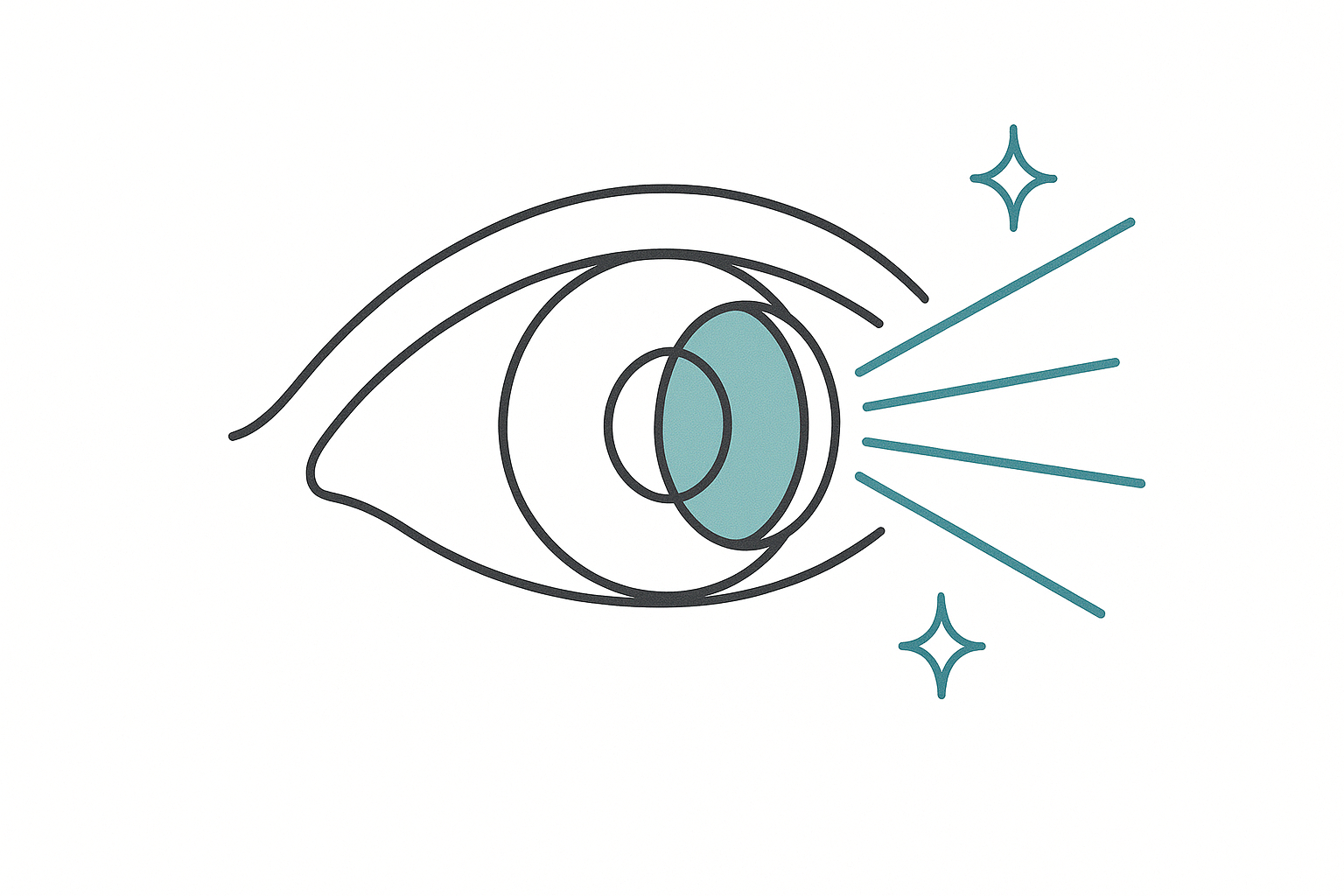
"I see a crescent of light on one side." "There is a shadow, like a curtain, at the edge of my vision."
These are two of the most common concerns I hear in the weeks after cataract surgery. Patients are understandably worried. They had surgery to see better, and now they are seeing something they did not have before.
These symptoms have a name: dysphotopsia. It is not a sign that something went wrong. It is a consequence of the physics of light passing through an artificial lens that is smaller, thinner, and shaped differently than the natural lens it replaced.
Understanding what dysphotopsia is, why it happens, and what to expect can make the difference between weeks of anxiety and the calm patience that allows your brain to do what it does best: adapt.
What you see: An arc, crescent, or streak of light, usually on the temporal side (toward your ear). Some patients describe it as a bright line or a flash that appears in certain lighting conditions.
Why it happens: Light hitting the edge of the lens implant is refracted or reflected internally, creating a visible artifact. Square-edge lens designs, which are standard because they help prevent posterior capsule opacification, are more likely to produce this effect.
The good news: This type almost always resolves within weeks to a few months. Your brain learns to ignore the artifact through neuroadaptation.
What you see: A dark shadow, crescent, or curtain-like area in your peripheral vision, typically on the nasal side (toward your nose). It can look like something is blocking part of your visual field.
Why it happens: This is more complex. The leading theory involves a gap between the edge of the lens implant and the iris, creating a shadow zone on the peripheral retina where light is not reaching. The natural lens was much larger and sat closer to the iris, so this gap did not exist before surgery.
The timeline: Negative dysphotopsia can be more persistent than positive dysphotopsia. Most cases still improve significantly over three to six months. A small number of patients have symptoms that last longer.

Your natural lens is about 9 to 10 millimeters in diameter and sits snugly against the back of the iris. It has a gradual transition zone at its edges. Light passes through it smoothly.
An artificial lens implant is typically 6 millimeters across, with well-defined, engineered edges. Those sharp edges serve an important purpose: they create a barrier that slows the migration of cells that would otherwise cloud the capsule behind the lens (posterior capsule opacification). But those same sharp edges also interact with light differently.
In other words, dysphotopsia is not a defect. It is a trade-off. The lens designs that best prevent complications also create the conditions that make these optical phenomena possible.
Not everyone experiences dysphotopsia. Several factors make it more likely:
A smaller pupil means light passes closer to the edge of the lens implant, increasing the likelihood of edge-related optical effects.
Square-edge designs (used to prevent PCO) are more associated with dysphotopsia than round-edge designs. Some newer lens platforms have modified edge profiles to reduce this.
Patients who need very high or very low power lens implants may have a greater mismatch between lens geometry and the capsular bag, contributing to optical artifacts.
When the natural lens was very large and the replacement is standard size, the gap between the lens edge and the iris can be more pronounced.
Lighter irises transmit more light through the tissue itself, which can amplify the perception of unwanted light phenomena.
Here is something remarkable about the human visual system: your brain is constantly filtering what you see. Right now, you are not aware of your nose in your visual field, even though it is always there. You do not see the blood vessels on the surface of your own retina, even though they cast shadows on the photoreceptors beneath them.
Your brain learns to suppress stable, predictable visual artifacts. This process is called neuroadaptation, and it is the primary reason most dysphotopsia resolves without any treatment at all.
The timeline varies by individual, but the pattern is consistent. Positive dysphotopsia typically fades within weeks to a few months. Negative dysphotopsia can take three to six months, sometimes longer. The key is patience.
I tell my patients: if the symptoms are not interfering with your daily activities, the best treatment is time. Your brain is working on the problem even when you are not thinking about it.
For the small percentage of patients whose dysphotopsia does not resolve with time and significantly affects their quality of life, there are options:
Because the vast majority of cases improve, waiting is almost always the first recommendation. I follow patients closely and reassess at regular intervals.
For persistent negative dysphotopsia, the lens optic can be repositioned so it sits in front of the capsule opening rather than behind it. This changes the light dynamics at the lens edge and can eliminate the shadow. It is a less invasive option than full lens exchange.
In rare cases where symptoms are debilitating and other options have been exhausted, the lens implant can be exchanged for one with a different edge design or diameter. This is a more complex surgery and is reserved for cases where the impact on quality of life justifies the additional risk.
The best way to manage dysphotopsia is to set realistic expectations before surgery. Not every patient will have a perfectly seamless visual transition from natural lens to implant. Most will. But the patients who struggle the most are often those who were never told these symptoms were possible.
Here is how I approach it:
The patients who handle dysphotopsia best are the ones who knew it could happen. Not because knowing makes the symptoms less real, but because it removes the fear. Fear amplifies perception. When a patient sees an arc of light and thinks "something is wrong," every glance becomes a test. When that same patient knows "this is a common optical artifact and my brain will learn to tune it out," the arc loses its power. Information is not just a courtesy. It is part of the treatment.
If you are seeing arcs of light, streaks, or dark shadows after cataract surgery, a careful evaluation can determine the cause and whether intervention is needed.