Fear & Education

What Happens If I Wait Too Long?

Cataracts do not heal on their own. They do not stay the same. And the surgery you could have today is not the same surgery you will have in three years.

He had been told two years earlier that he had cataracts in both eyes. His optometrist mentioned it during a routine exam, almost in passing. "You have early cataracts. Nothing to worry about right now." So he did not worry. He waited. And when he finally came to see me, his cataracts were no longer early.

His right eye was 20/100. His left was 20/80. He had stopped driving at night months ago. He could not read the menu at restaurants without the flashlight on his phone. His wife had started reading the prescription labels for him.

"I thought I was supposed to wait until they were ready," he said.

That phrase comes up constantly. "Ready." As if a cataract reaches some magical point where a bell rings and the timing is perfect. It does not work that way. There is no bell. There is only a gradual narrowing of what you can see, what you can do, and eventually, what options are available to you.

The Cataract Does Not Stop

A cataract is a clouding of the natural lens inside your eye. It starts gradually and progresses at its own pace. Some patients have a slowly changing cataract for a decade. Others see significant decline in a year or two. But in every case, the direction is the same: the lens becomes cloudier, denser, and harder over time.

There is no medication, no eye drop, no supplement that reverses a cataract. Once the protein structure of the lens begins to change, the only treatment is surgical removal and replacement with an artificial intraocular lens.

When I tell patients this, some hear it as pressure. It is not. It is simply the biology. I am not rushing anyone into surgery. But I want patients to understand that waiting does not keep things the same. Waiting means the cataract continues to change, and those changes have consequences.

What Changes When You Wait

The most immediate consequence of waiting is the one patients already feel: declining vision. But the changes happening inside the eye matter just as much, because they affect the surgery itself.
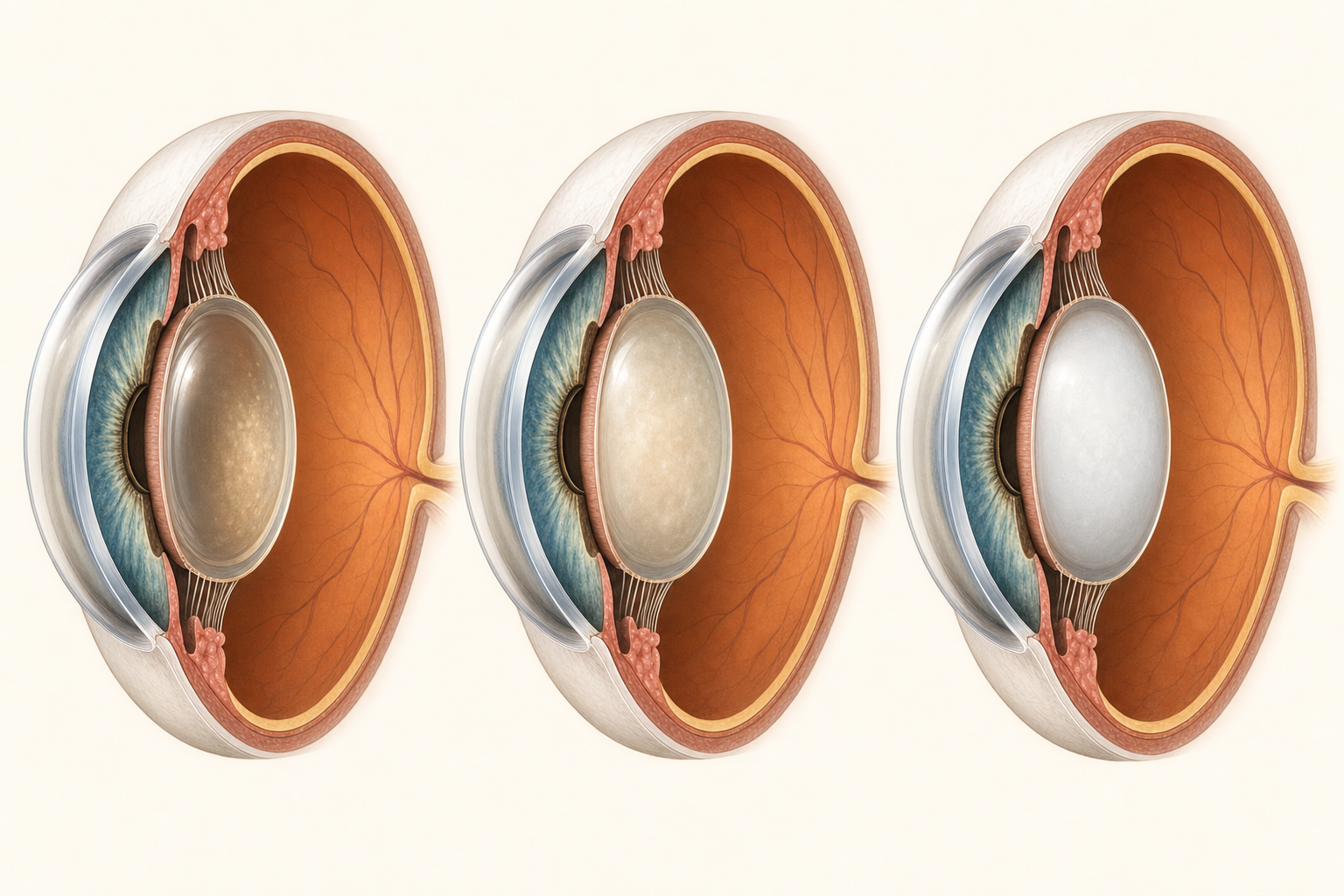
Illustration showing progressive clouding of the eye lens from early to dense cataract stages

As a cataract progresses from early to dense, the lens becomes harder, more opaque, and significantly more challenging to remove safely.

The lens gets harder.

In early cataract surgery, the lens material is soft. It breaks apart easily with the ultrasonic energy we use during phacoemulsification. The surgery is smooth, controlled, and efficient. A dense cataract is a different procedure entirely. The lens is rock hard. It requires more energy, more time, and more manipulation inside the eye. Every additional minute of ultrasonic energy means more stress on the corneal endothelium, the delicate cell layer on the inside of the cornea that keeps your vision clear.

The capsule is at greater risk.

The lens sits inside a thin, transparent membrane called the capsular bag. During surgery, we carefully open the front of this capsule, remove the cataract through that opening, and then place the new artificial lens inside the intact bag. When the cataract is dense, the forces involved in breaking it apart put the capsule under significantly more stress. The risk of a posterior capsule rupture, the most common serious complication of cataract surgery, goes up. An experienced surgeon can manage this, but the margin for error is smaller.

Measurements become less accurate.

Before surgery, we perform detailed measurements of the eye to calculate the correct power of the artificial lens. These measurements rely on light passing through the natural lens. When the cataract is dense, less light gets through. The readings become less reliable. This can affect the precision of your lens power calculation, which means a greater chance of needing glasses after surgery or even an additional procedure to fine-tune the result.

Waiting does not make surgery impossible. It makes surgery harder. And the harder the surgery, the less predictable the outcome.

The Lens Options Narrow

This is the part many patients do not expect. When you wait too long, the conversation about lens choice changes.

Premium lenses, multifocal, extended depth of focus, and toric lenses for astigmatism, all depend on precise preoperative measurements. When those measurements are compromised by a dense cataract, the confidence in a premium lens outcome drops. I have had patients who came in hoping for a multifocal lens and had to be counseled that a monofocal lens was the safer, more predictable option because their cataract had progressed too far for accurate measurement.

That is not a failure of the technology. It is a consequence of timing. The same patient, two years earlier, would have been an excellent candidate for exactly the lens they wanted.

A senior struggling to read a book under a lamp, illustrating the gradual vision loss from untreated cataracts

As cataracts progress, everyday tasks like reading require increasingly brighter light, magnification, or both. Many patients do not recognize how much they have adapted until after surgery.

There is also the question of intraoperative guidance. Tools like the ORA system, which measures the eye during surgery to refine lens power in real time, work best when the surgical field is clean and predictable. A complicated procedure with a dense cataract can limit the usefulness of these tools.

The Hidden Risks

Beyond the surgical complexity, a very mature cataract can create secondary problems that have nothing to do with the surgery itself.

A swollen, mature cataract can push the iris forward and narrow the drainage angle of the eye. This can trigger acute angle closure glaucoma, a sudden and painful spike in eye pressure that requires emergency treatment and can cause permanent optic nerve damage if not addressed quickly.

A hypermature cataract can also leak protein through the capsule, causing a type of inflammation called phacolytic glaucoma. This is rare, but it happens, and it is entirely preventable with timely surgery.

There is another risk that is less dramatic but equally important: a dense cataract makes it harder to examine the retina. If you have risk factors for macular degeneration, diabetic retinopathy, or glaucoma, a cataract that blocks the view to the back of the eye can delay detection of those conditions. I have seen patients whose retinal disease was not identified until after cataract surgery because the cataract was too dense for a proper exam.

"I kept telling myself I would do it next year. Then next year became three years, and by then I could barely see faces across the room."

What Patients Actually Lose

The clinical consequences matter. But what patients lose in the meantime matters just as much.

I see patients who have quietly stopped doing things they love. They stopped golfing because they could not track the ball. They stopped reading because the effort was exhausting. They stopped driving at night because the glare from oncoming headlights was unbearable. They stopped cooking because they could not read recipes. One patient told me she had not seen her grandchildren's faces clearly in over a year.

These are not dramatic emergencies. They are slow erosions of daily life. And because cataracts progress gradually, patients adapt. They compensate. They increase the brightness on their phone. They hold books closer. They stop going out after dark. The adaptation is so gradual that many patients do not realize how much vision they have lost until after surgery, when they see clearly for the first time in years and say, "I did not know it was this bad."

A senior couple walking outdoors in bright desert sunlight, representing the independence that clear vision provides

The activities patients give up while waiting for cataract surgery are often the ones that define their quality of life. Many do not recognize the full impact until their vision is restored.

So When Is the Right Time?

There is no universal formula. Cataract surgery is not an emergency in most cases, and I never pressure a patient to proceed before they are ready. But "ready" should not mean "nearly blind."

I tell patients that the right time is when your vision is affecting your daily activities, your safety, or your quality of life. If you are struggling to drive, to read, to see faces, to do the things that matter to you, that is a signal.

The sweet spot for cataract surgery is when the cataract is significant enough to justify the procedure but not so advanced that it complicates it. At that point, the surgery is faster, the recovery is smoother, the measurements are most accurate, and the full range of lens options is available to you.

The patient I described at the beginning? We operated successfully. His outcome was good. But the surgery was harder than it needed to be. The ultrasonic energy was higher, the surgical time was longer, and his recovery took an extra week compared to what it would have been two years earlier. He got his vision back. But he did not get those two years back.

The best cataract surgery is the one done at the right time. Not too early, when vision is still good. Not too late, when the procedure is harder and the options are fewer. The window matters, and it is wider than most patients realize.

Related Reading

Concerned About Waiting?

If you have been told you have cataracts and you are not sure when to proceed, a consultation can clarify where you stand. Understanding your options now gives you the best chance of the best outcome later.

Desert Vision Center
35900 Bob Hope Dr, Suite 175
Rancho Mirage, CA 92270

Serving Rancho Mirage, Palm Desert, Indian Wells, La Quinta, Palm Springs, and the Coachella Valley.

Schedule Your Consultation