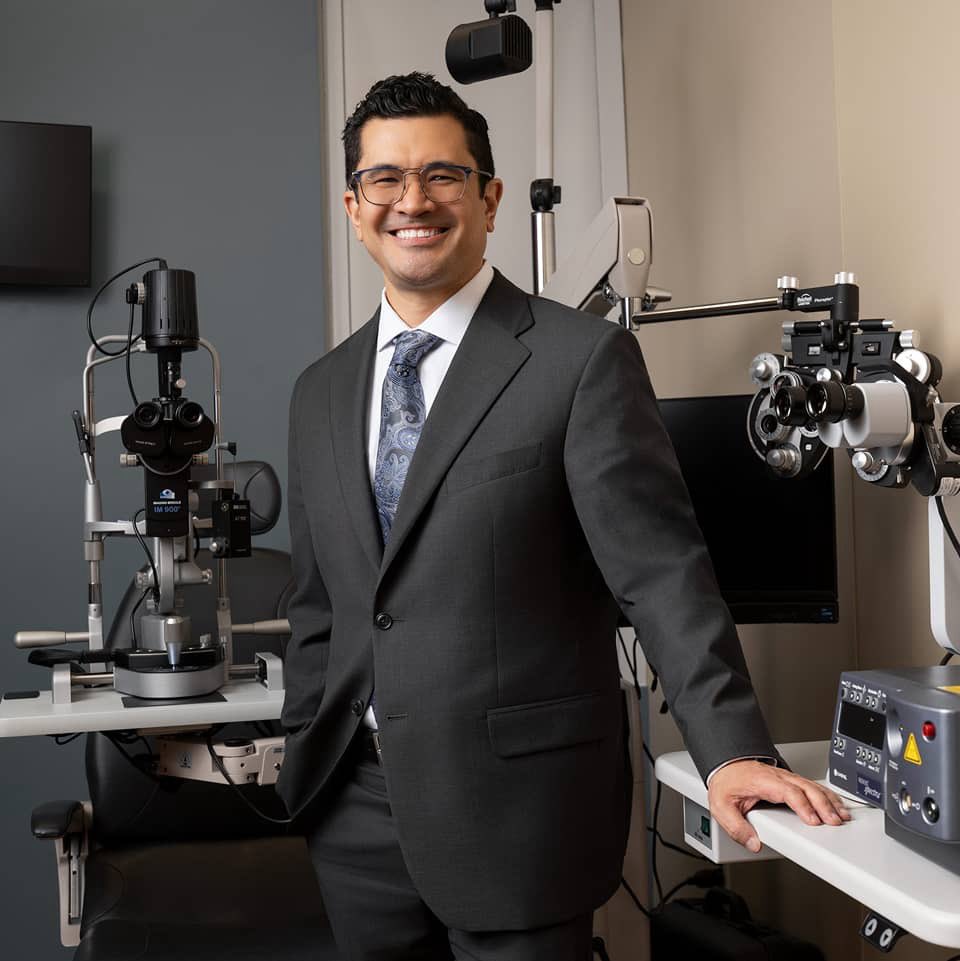
Dr. Tokuhara examining a patient at the slit lamp

Is Cataract Surgery Safe?

An honest answer: yes, with important context about what that means for your eyes specifically.

The Short Answer

Yes. Cataract surgery is one of the safest elective surgical procedures in all of medicine. More than 4 million procedures are performed in the United States every year, with an overall success rate exceeding 99 percent.

That is not marketing. That is the published literature, confirmed by decades of outcomes data from practices around the world.

But that is also the population-level answer. Your individual situation may involve factors that shift the risk profile. And surgery performed by a high-volume, fellowship-trained surgeon is meaningfully different from surgery performed by someone with limited experience in complex cases. The statistics are reassuring. The specific details of your eyes and your surgeon matter too.


Patient consultation at Desert Vision Center

What Makes It Safe

Modern cataract surgery bears little resemblance to the procedure of even 20 years ago. Several advances have made it both more effective and safer:

Small-incision phacoemulsification.

The cloudy lens is removed through an incision typically less than 3mm. This reduces astigmatism compared to older large-incision techniques, heals without sutures in most cases, and significantly lowers infection risk.

Topical anesthesia.

Eye drops numb the eye for surgery. There is no needle near the eye, no injection behind the eye, and no general anesthesia required. This removes an entire category of risk that older approaches carried.

Outpatient procedure.

Surgery takes less than 20 minutes for most straightforward cases. Patients go home within an hour. Shorter exposure time and minimal facility stay reduce hospital-associated risks.

Quick recovery.

Most patients notice improved vision within 24 hours. Full visual stabilization typically occurs by 4 to 6 weeks. There are no stitches to remove and no prolonged activity restrictions for most patients.

The Risks That Do Exist

Being honest about safety means acknowledging that cataract surgery, like all surgery, carries real risks. Most are uncommon. Most are manageable when recognized and addressed appropriately.

Common and expected: mild inflammation, light sensitivity, and fluctuating vision in the first days after surgery are normal. Posterior capsule opacification, a cloudiness that develops months to years later, occurs in up to 30 percent of patients and is treated quickly with a brief laser procedure.

Less common but important: elevated eye pressure, persistent corneal swelling, and retinal detachment are more serious. Dropped nuclear fragments require additional surgery to remove. These happen in a small fraction of cases, but they happen. A surgeon who tells you complications never occur is not being honest with you.

For a complete look at what can go wrong and how I manage it, see the Cataract Surgery Complications guide.

Safer With the Right Surgeon

Precision in cataract surgery - experience and volume make a measurable difference

Surgical volume is not vanity. A surgeon who has performed 10,000 procedures has seen a range of complications, unusual anatomy, and unexpected intraoperative findings that a surgeon with 500 cases has not. This experience builds the instinct to recognize a problem early and respond before it escalates.

Fellowship training in anterior segment surgery provides specialized preparation that residency alone does not. It teaches not just technique, but the judgment to know when to pause, when to adapt, and when to convert to a different approach.

Complication management is as important as complication avoidance. The best surgeons are not the ones who never have complications. They are the ones who recognize complications quickly, handle them skillfully, and communicate honestly with patients throughout.

I have performed more than 10,000 cataract procedures. My dual fellowship training covers both anterior segment surgery and medical retina, which gives me a perspective on the full visual system that most cataract surgeons do not have. I also take on complex and revision cases referred by other surgeons. For more on what that training means in practice, see the Choosing Your Surgeon guide.

Conditions That Need Extra Planning

Certain pre-existing conditions increase the complexity of cataract surgery. They do not make surgery impossible or necessarily more dangerous. But they require a surgeon with the experience and preparation to manage them:

Pseudoexfoliation syndrome.

Weakened zonular fibers can lead to complications during surgery. Specialized tools and technique adjustments are needed.

Prior corneal refractive surgery (LASIK, RK).

Previous corneal procedures alter the measurements used to select lens power. Standard formulas can produce inaccurate results. Specialized calculations are required.

Fuchs endothelial dystrophy.

Corneal swelling is more likely after surgery. Surgical technique and lens selection must account for corneal health before and after the procedure.

Dense cataracts, diabetes, prior retinal surgery.

Each presents distinct surgical challenges that require evaluation during the pre-operative workup. An experienced surgeon plans for these during preparation, not during surgery.

If any of these apply to you, it is not a reason to avoid surgery. It is a reason to seek a surgeon with specific experience. See complex cataract cases for more detail on each condition.

A thought from the clinic

Patients often ask me if cataract surgery is safe, and I tell them yes. But then I tell them the rest: that the statistics are population-level, that their individual risk profile depends on their eyes and their surgeon, and that being in the right hands changes the equation significantly. I have performed more than 10,000 of these procedures. What I offer is not just technique. It is the experience to recognize when something unusual is happening and the judgment to respond. That combination is what safety actually looks like in practice.

Schedule a ConsultationCall 760.340.4700

Learn More