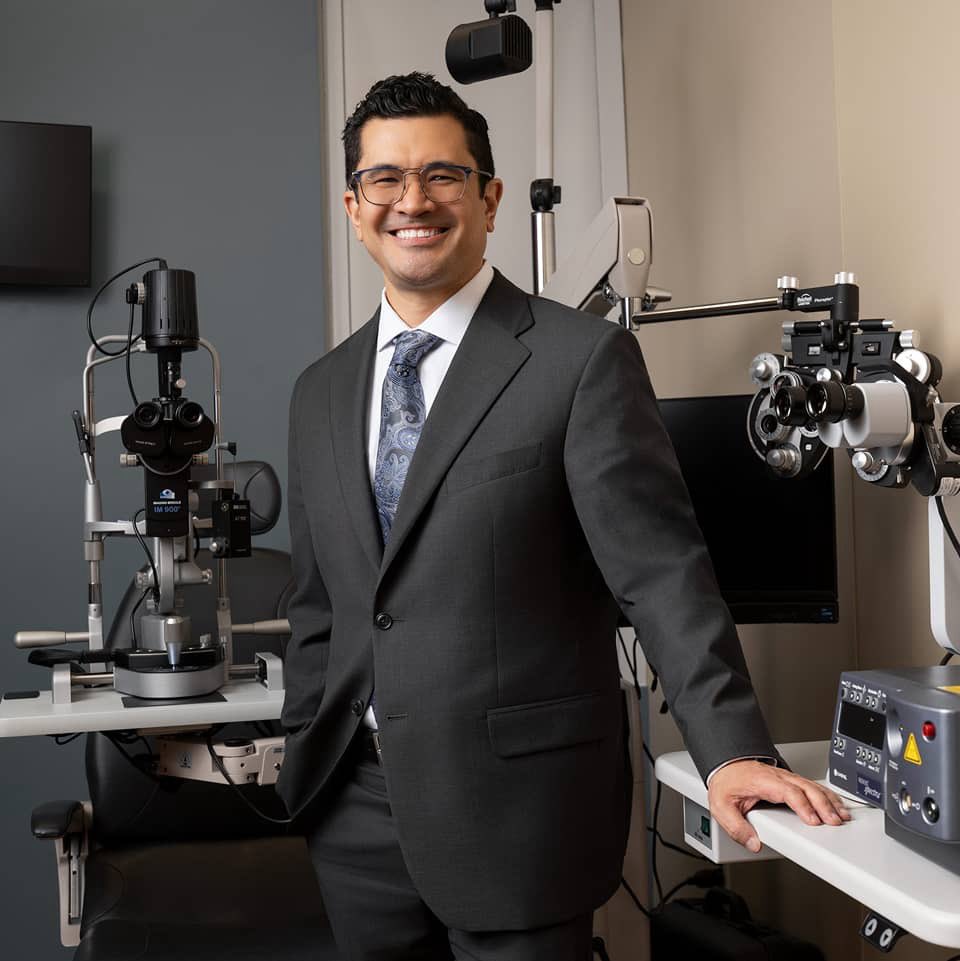
A 59-year-old physician came to my office for a cataract evaluation after noticing worsening vision in his left eye over several months. He had previously undergone LASIK for nearsightedness many years earlier and had enjoyed good vision for a long time afterward.
But now things were changing.
As a procedural specialist, his vision was not just about convenience. It directly affected how he worked, how confidently he performed procedures, and how efficiently he moved through long days of patient care.
He told me something many surgeons quietly worry about but rarely say out loud: even small declines in visual quality can become mentally exhausting when your profession depends on precision.
His examination showed 20/20 vision in the right eye but 20/50 vision in the left eye with a significant myopic shift requiring about a -4 prescription. We could clearly see the old LASIK flaps in both corneas, along with some mild interface haze in the left eye. He also had a moderate nuclear sclerotic cataract in that eye, which explained both the progressive blur and the refractive shift.
From a clinical standpoint, this case was interesting because several factors had to be balanced carefully.
Patients with prior myopic LASIK often require more detailed planning before cataract surgery because previous corneal reshaping can affect intraocular lens calculations. In addition, this patient’s professional demands were highly specific. He spent much of his day working at near and intermediate distances: operating, reviewing charts, documenting on computers, and interacting with patients in examination rooms.
In other words, his visual priorities were different from someone whose primary goal might be driving or distance activities.
The Lens Discussion
We spent a long time discussing lens options, visual goals, and realistic trade-offs. He strongly desired spectacle independence because constantly switching between glasses during procedures and patient care disrupted his workflow and concentration.
Ultimately, he chose a Vivity lens, an extended depth-of-focus intraocular lens designed to provide a broader range of vision with relatively minimal nighttime visual side effects compared to some multifocal lenses.
But equally important was the refractive target.
Rather than aiming for perfect distance vision, we intentionally targeted slight residual myopia in the operated eye. That decision was highly personalized to his lifestyle and work demands. By leaving him slightly nearsighted, we optimized his ability to function comfortably at near and intermediate distances without glasses.
The Outcome
His surgery went smoothly and without complications.
After surgery, he achieved excellent uncorrected near and intermediate vision. He could comfortably perform computer work, review patient charts, and function in procedural settings without glasses. For distance, he measured approximately 20/40 uncorrected and corrected to 20/20 with glasses. He still prefers glasses for nighttime driving, but for the majority of his daily life, he functions independently without correction and remains extremely happy with the outcome.

What I appreciate about this case is that it demonstrates an important truth about modern cataract surgery: success is not one-size-fits-all.
The Personalization Principle
Many patients assume cataract surgery is simply about “making vision 20/20.” But in reality, vision is personal. A professional photographer, a truck driver, a pilot, a teacher, and a surgeon may all prioritize completely different things even if they technically have the same eye condition.
The psychology behind these decisions matters just as much as the measurements.
For highly detail-oriented professionals, vision problems often create a unique type of stress. It is not only the fear of blur itself. It is the fear of losing efficiency, confidence, precision, or independence in an environment where performance matters deeply. In medicine especially, physicians are often uncomfortable becoming patients themselves. They are used to being the one solving problems, not experiencing vulnerability. This patient approached the process thoughtfully, analytically, and with a clear understanding that every lens choice involves compromise.
And that is one of the most important philosophical lessons in ophthalmology.
There is no perfect lens.
"The goal is not perfection in every category simultaneously. The goal is alignment between the technology and the patient's real life."
Every visual solution in life involves trade-offs. The goal is not perfection in every category simultaneously. The goal is alignment between the technology and the patient’s real life.
Sometimes the best outcome is not the sharpest distance chart measurement. Sometimes it is the ability to move naturally through daily life with less friction, less dependence, and greater ease.
For this patient, the ability to work comfortably at near and intermediate distances mattered more than being completely glasses-free for nighttime driving. Once that priority became clear, the surgical plan became clearer too.
Customization, Not Just Surgery
That is where cataract surgery becomes more than a procedure. It becomes customization.
The best cataract surgery is not simply about removing a cloudy lens. It is about understanding how a patient lives, works, reads, drives, creates, and experiences the world.
Because ultimately, the best vision is not the same for everyone.