A practical guide for Coachella Valley residents: what to do, what to avoid, and when desert dust becomes a medical problem.
If you live in the Coachella Valley, you know what it feels like to step outside and immediately have something blow into your eye. Wind-blown dust, fine sand, pollen, and particulates are part of everyday life here in ways that people in other climates simply do not experience. I see the consequences of that in my practice regularly.
Most of the time, it is manageable. Blink a few times, rinse your eye, and move on. But desert residents - more than most populations - are at elevated risk for chronic eye surface conditions caused by repeated exposure to dust, dry air, UV radiation, and wind. Knowing the right response in the moment, and knowing when something needs medical attention, is genuinely useful here.
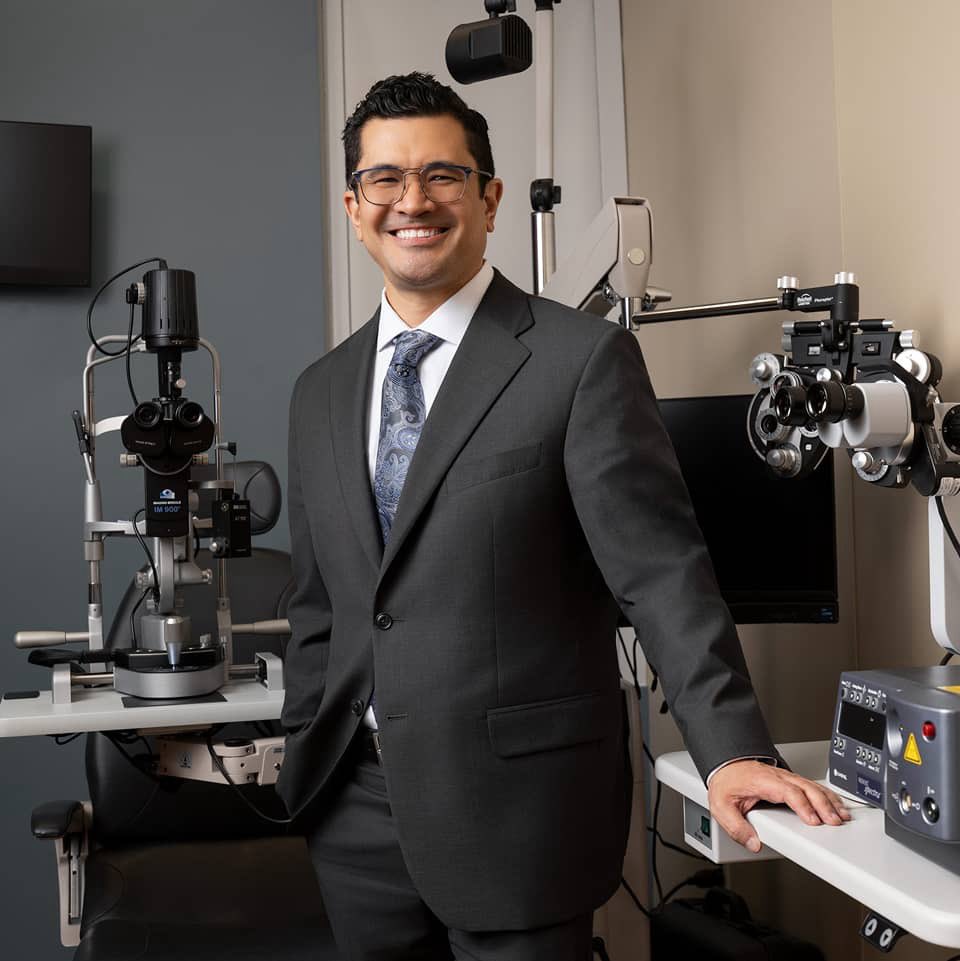
As featured in a KESQ news segment, I want to share the practical guidance I give my patients every day.
Dr. Tokuhara on KESQ News: Desert Eye Care

When something gets in your eye, the instinctive response is to rub it. That instinct is almost always wrong.
Rubbing pushes the debris deeper into the conjunctival folds, where it is harder to flush out and more likely to cause irritation. Worse, it can drag a particle across the cornea, the clear surface at the front of your eye. Even a tiny grain of sand, when rubbed across the cornea, can cause a corneal abrasion - a painful scratch that can take days to heal and is vulnerable to infection.
The rule is simple: no rubbing. Even if it itches. Even if it burns. Rub, and you risk turning a minor irritation into a genuine injury.
Beyond the immediate problem of a particle in your eye, desert residents face a set of chronic eye conditions that are more common here than in other environments:

A good pair of sunglasses is the single most effective thing a desert resident can do to protect their eyes year-round. Here is what that means in practice:
Sunglasses act as a physical barrier against wind-blown dust, sand, and particles. Wraparound styles offer better coverage than standard frames. But the protection does not stop there - sunglasses also block ultraviolet radiation, which is intense in the desert and contributes to cataracts, macular degeneration, and pterygium (a growth on the white of the eye caused by UV and wind exposure).
Look for lenses that block 100 percent of both UVA and UVB radiation. Polarized lenses reduce glare on sunny desert days, which is especially useful for driving. A hat with a brim adds further protection by limiting overhead UV exposure.
I tell my patients: sunglasses in the desert are not optional. They are medical equipment.
Most cases of dust or debris in the eye resolve with the steps above. But some situations need professional evaluation. Come in or call us if you have:
Most eye irritations from dust and wind are minor and self-resolving. But the desert environment means your eyes are under more daily stress than they would be almost anywhere else in the country. Protecting them with sunglasses, not rubbing when debris gets in, and knowing when to call are the three things that will make the biggest difference over time.
Ocular surface disease is a broad category that includes dry eye syndrome, blepharitis, meibomian gland dysfunction, and chronic conjunctival irritation. It is common everywhere, but it is more common in desert environments.
The reasons are straightforward. Low humidity accelerates tear evaporation, reducing the protective tear film on the cornea. Wind increases exposure to particulates and accelerates that same evaporation. UV exposure damages the surface cells of the eye and the conjunctiva over time. Add high temperatures and limited shade, and you have an environment that is genuinely hard on the eye surface.
Many patients who come to me with cataracts also have significant ocular surface disease. This matters because cataract surgery outcomes depend in part on a healthy eye surface. I evaluate and treat surface disease as part of surgical preparation whenever needed. This is one of the ways that thorough preoperative care makes cataract surgery outcomes better.
If you have been experiencing chronic dry, itchy, red, or gritty eyes - and you live in the desert - it is worth getting evaluated. These conditions are treatable, and treating them improves your comfort and your long-term eye health.
Desert Vision Center treats the full range of eye surface conditions common in the Coachella Valley. Let’s take a look.